NEED HELP NOW? Call 911 for emergencies. Call or text 988 for mental health or substance use crises. Local 24/7 support: 262-657-7188.

262-658-8166

6103 39th Avenue, Kenosha, WI 53142

262-658-8166

6103 39th Avenue, Kenosha, WI 53142

NEED HELP NOW? Call 911 for emergencies. Call or text 988 for mental health or substance use crises. Local 24/7 support: 262-657-7188.

NEED HELP NOW? Call 911 for emergencies. Call or text 988 for mental health or substance use crises. Local 24/7 support: 262-657-7188.

Alcohol2026-07-30T11:22:22-05:00
Substance Information

Alcohol

Alcohol is legal, social, and everywhere — which is exactly what makes harmful use hard to recognize, in ourselves and in the people we love. This page covers the facts: what the real risks are, when drinking crosses into something worth a conversation, and where support starts in Kenosha County. No shame anywhere on this page. Just information you can use.

Alcohol, at a glance

Legal doesn’t mean low-risk

Alcohol affects health, relationships, work, school, driving, and safety — and risk rises with how much, how often, and what else is in the picture.

When risk climbs

Heavy use, binge drinking, underage drinking, drinking during pregnancy, and mixing alcohol with medications or other substances all raise the stakes considerably.

What lowers risk

Clear limits, never driving after drinking, not mixing alcohol with medications or other substances, and reaching out early — before concerns become consequences.

Local support exists

Assessment, peer support, family support, testing, treatment navigation, and prevention education — all available through Hope Council.

The terms, in plain language

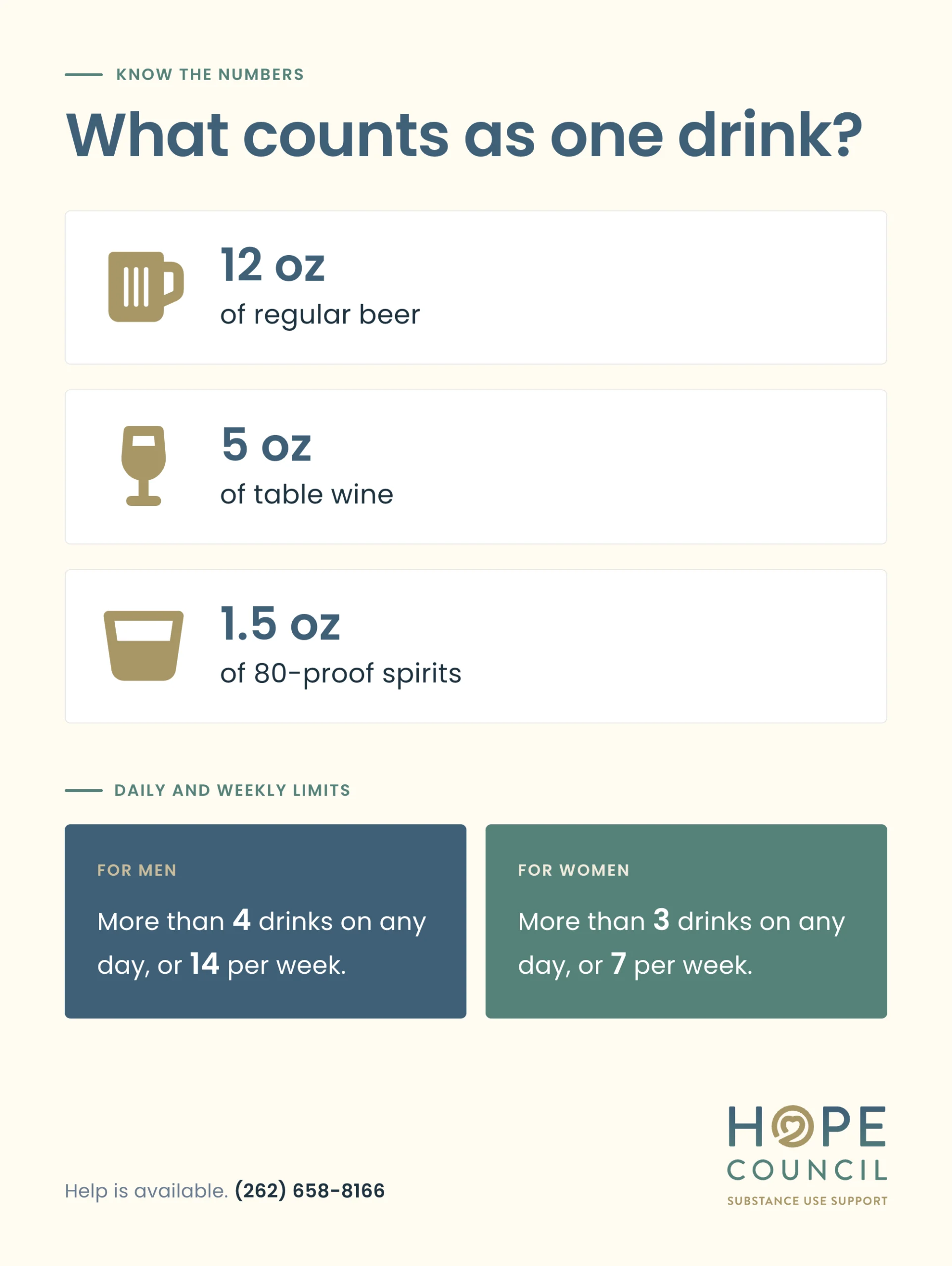
What Counts As One Drink Graphic Selection (1)

A generous pour of wine, a strong craft beer, or a heavy-handed cocktail can be two standard drinks or more.

Moderate drinking is generally defined as up to one drink per day for women and two for men — though less is always lower-risk, and no amount is risk-free.

Binge drinking means reaching a blood alcohol level of 0.08% or higher — typically four or more drinks for women, five or more for men, within about two hours. It is the most common and most underestimated pattern of harmful use.

Heavy drinking means binge drinking on five or more days in a month, or consistently exceeding moderate levels.

Underage drinking carries elevated risks because the brain continues developing into the mid-20s — earlier use is linked to higher rates of dependence later.

Alcohol during pregnancy has no known safe amount, at any stage.

Where the risks actually land

Right now

Injuries, falls, and accidents. Impaired driving. Alcohol poisoning — which is a medical emergency. Risky decisions that can’t be taken back.

Over time

Liver disease, heart disease, high blood pressure, and increased risk of several cancers. Alcohol is also closely linked with depression and anxiety — each can drive the other.

Around you

Conflict at home, strained relationships, trouble at work or school, and the quiet toll on the people who care about you.

With other substances

Alcohol with opioids, benzodiazepines, sleep medications, or other depressants multiplies overdose risk. Alcohol with any medication deserves a conversation with a pharmacist or doctor.

Alcohol poisoning is a medical emergency

Recognize
  • Confusion, or being impossible to wake up.
  • Vomiting, especially while passed out.
  • Slow breathing (fewer than 8 breaths a minute) or irregular breathing.
  • Cold, clammy, pale, or bluish skin.
  • Seizures.
Respond
  • Call 911. Alcohol poisoning can stop a person’s breathing — this is not a sleep-it-off situation.
  • Turn the person on their side so they cannot choke if they vomit.
  • Stay with them until help arrives.

The myth that costs lives: “Let them sleep it off” is how people die from alcohol poisoning. Blood alcohol can keep rising after someone stops drinking and passes out. If you are not sure whether it’s an emergency, treat it like one — nobody has ever regretted the ambulance that wasn’t needed

Worth a conversation if…

  • Trying to cut back has been harder than expected.
  • Needing more to feel the same effect.
  • Legal concerns, including an OWI.
  • Drinking to handle stress, sleep, or feelings.
  • Drinking more, or more often, than intended.
  • Conflict at home or work that traces back to drinking.
  • Someone you trust has said they’re worried.
  • Mixing alcohol with medications or other substances.
None of these means a verdict. Each one means a conversation could help — and you can have that conversation before things are at their worst.

Safety note: Stopping suddenly after sustained heavy drinking can be dangerous. Talk with a medical professional before attempting to detox on your own.

Cutting back counts too

Not everyone reading this page wants to stop drinking — plenty of people just want to drink less. That is a legitimate goal, and these steps actually work:


  • Track what you actually drink for two weeks. Most people are surprised, and you can’t change a number you don’t know.
  • Build in alcohol-free days — and protect them.
  • Don’t keep a stock at home. Friction helps.
  • Tell one person what you’re doing. Quiet goals are easy to quietly drop.
  • Decide your limit before the first drink, not during the third.

If cutting back keeps not working, that is information, not failure — and it’s exactly the kind of thing peer support is for. No cost, no judgment, and nobody will tell you that you have to quit.

Support for whatever this page brought up

For you

Confidential AODA assessments, no-cost peer support from people with lived experience, and navigation to treatment that fits.

For someone you love

Guidance for the conversation, the free Loved Ones Support Group every Thursday, and support that doesn’t require their readiness.

Driving or testing requirements

The Intoxicated Driver Program for OWI requirements and alcohol testing (EtG, PEth, breathalyzer) by appointment with published fees.

Schools, workplaces, and groups

Evidence-based alcohol education for classrooms, teams, and community audiences — fees based on ability to pay.

Common Questions

How do I know if my drinking is becoming a problem?2026-07-09T14:48:14-05:00

There’s no single test — the signs list above is the practical answer. You don’t need to be sure before reaching out, and a conversation costs nothing: 262-658-8166.

Can Hope Council help with an alcohol assessment?2026-07-09T14:48:29-05:00

Yes. Confidential AODA assessments by licensed practitioners, no referral required — for court, employer, or licensing requirements, or just for your own clarity.

Does Hope Council provide alcohol testing?2026-07-09T14:48:41-05:00

Yes — EtG (4–6 month window), PEth (3–5 week window), and breathalyzer (within hours), all by appointment with published fees. See Alcohol & Drug Testing.

Is it safe to quit drinking cold turkey?2026-07-09T14:48:55-05:00

After sustained heavy drinking, suddenly stopping can be dangerous — withdrawal from alcohol can be medically serious. Talk with a medical professional before detoxing on your own, and call 262-658-8166 to talk through safer options.

Health content on this page aligns with current CDC and NIAAA guidance. Reviewed by Hope Council staff. July 23rd, 2026

Go to Top